The City Council will adopt a budget at their meeting on Tuesday, June 24 that relies heavily on the use of Measure Q dollars (the extra half-cent sales tax) to provide core services.
City staff has also informed the Council and community that approximately $4 million in budget cuts will be necessary to keep future budgets balanced should Measure Q expire in 2016.
Measure Q was approved by voters in 2010 for a five-year term. At the time city leaders thought five-years of additional revenue would be enough to see the economy recover and see our property tax and sales tax revenue return to pre-recession levels. That hasn’t happened yet.
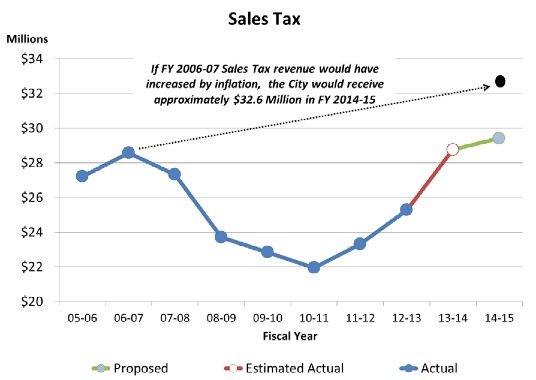
While the sales tax revenue projected for 2014-15 of $29.4 million has matched or exceeded the amount received in the 2006-07 fiscal year the property tax revenue projected for 2014-15 of $20.1 million is still below the $22.5 million received in 2007-08. And despite cuts to staffing and programs, the relatively low rates of inflation over the past seven years has further eroded the purchasing power of those dollars. The chart above shows that had the city’s peak sales tax revenue year grown with inflation we would be taking in $32.6 million or $3.2 million more next year.
Clearly, the “adopt a five-year temporary half-cent sales tax and hope the economy recovers plan” didn’t work. It protected core-city services – as promised, but it did not put the city in a sustainable position to provide those services using only existing sales and property tax revenues.
The voters need to be given the opportunity to extend Measure Q this November.
But before the measure is drafted the City needs to adopt a Long-term Financial Plan. Not a bunch of specifics but slightly more focused than the Council’s “Priority Focus Areas.”
Here’s my suggestion for the priorities of any Measure Q extension:
- Protect core or essential city services.
- Maintain a healthy budget reserve.
- Address deferred and regular maintenance of city assets, like roads, city buildings and parks.
- Eliminate our debts to retiree medical and current employee pension programs.
- Ensure the tax will not need to be extended again.
The key to meeting all five priorities – but especially #5 – is choosing a term for the extension of the tax (5 years? 7 years? 10 years?) that will provide enough funding to get the city’s fiscal house in order and maintaining enough discipline – see #5 – that no one forgets that priorities #1-4 ultimately need to be paid for out of recurring revenue from our standard property and sales tax sources.
Learn More:
Review the City Council Agenda for June 24, 2014
Read the Staff Report on the 2014-15 Proposed Budget


Leave a Reply